



What is a Calendar?

A calendar is a structured system for organizing days, weeks, and months within a year, assisting people in efficiently managing time. It is a chart or a collection of pages that presents the days and months in an orderly fashion, allowing us to monitor dates, plan events, and regulate daily schedules.
Calendars divide a year into 12 months, with each month containing either 30 or 31 days, except for February, which has 28 days in a standard year and 29 days in a leap year. Understanding calendars enables us to interpret dates correctly and count days accurately.
How to Read a Calendar?

To interpret a calendar, one must understand how time is segmented into different units. A year is composed of 12 months, which are:
January, February, March, April, May, June, July, August, September, October, November, and December.
Each month is further split into approximately four weeks, and each week consists of seven days:
Sunday, Monday, Tuesday, Wednesday, Thursday, Friday, and Saturday.
By grasping these divisions, one can easily pinpoint specific dates, track upcoming occasions, and coordinate schedules efficiently.
Uses of a Calendar
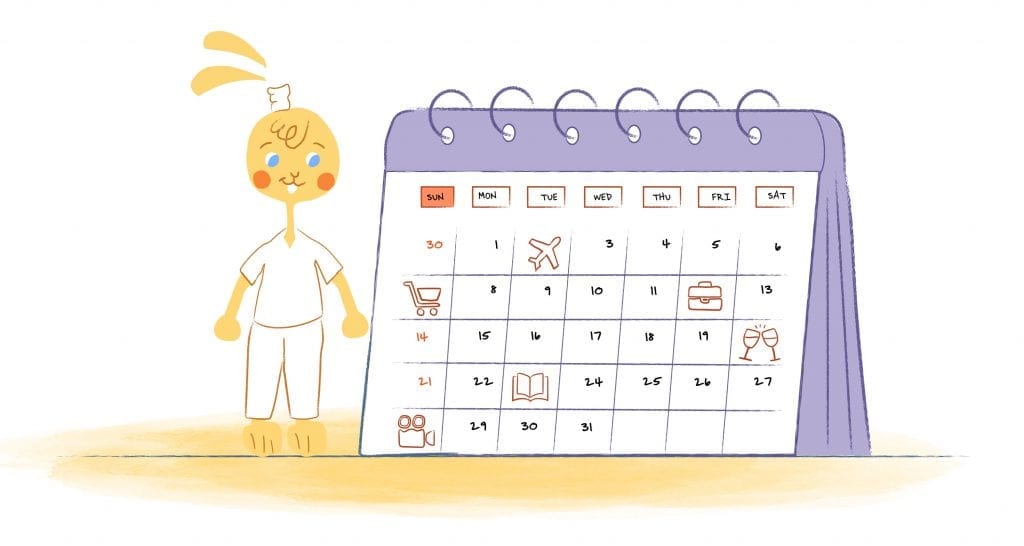
Calendars serve multiple functions in our everyday lives, such as:
- Tracking dates: Helps in keeping records of past, present, and future dates.
- Scheduling events: Assists in organizing meetings, birthdays, and special occasions.
- Managing time for longer duration: When preparing for exams like NEET it helps tracking exam dates to stay on top of preparation.
- Managing tasks: Aids in structuring daily routines and important deadlines.
- Historical references: Provides insights into past events and aids in planning accordingly.
Counting Days in a Calendar

When determining the number of days in a month, consider the following:
- Months with 30 days: April, June, September, November.
- Months with 31 days: January, March, May, July, August, October, December.
- February: Has 28 days in a standard year and 29 days in a leap year.
A simple technique to remember the number of days in each month is the knuckle method. Start from one knuckle on your fist, placing January on the first knuckle, February in the gap, March on the next knuckle, and so on. When you reach the last knuckle, continue from the first knuckle of the opposite hand. Knuckles represent months with 31 days, and gaps signify months with 30 days (except for February).
What is a Leap Year?

A leap year is a year that includes an extra day in February (29 days instead of 28). It happens every four years to compensate for the extra 6 hours the Earth takes each year to complete its revolution around the Sun.
Rules to Identify a Leap Year:
- A year must be divisible by 4 (e.g., 2004, 2008, 2012 were leap years).
- If it is a century year (e.g., 1900, 2000), it must be divisible by 400 to qualify as a leap year.
- Example: 1900 was not a leap year (not divisible by 400), but 2000 was a leap year (divisible by 400).
Solved Examples
- How many total days does this month have?
If a month begins on the 1st and ends on the 31st, it has 31 days. - How many Saturdays are in a month?
If a month contains 5 Saturdays, they will fall on dates such as 2nd, 9th, 16th, 23rd, and 30th. - Which day does March 20th fall on?
Checking the calendar, March 20th is Wednesday. - How many days are there from September 15th to November 7th?
September: 16 days, October: 31 days, November: 7 days
Total days = 16 + 31 + 7 = 54 days - What day is five days before Christmas?
Christmas falls on December 25th. Counting back 5 days, it lands on December 20th (Friday). - What is the date of the 4th Thursday in a month?
The 4th Thursday of the month typically falls on the 22nd.
Interesting Facts About Calendars
- A year actually consists of 365 days and 6 hours due to Earth’s revolution around the Sun.
- These extra 6 hours per year accumulate over four years to form an extra day (24 hours), which is added to February in a leap year.
- Different civilizations have employed various calendar systems, such as the Gregorian, Julian, and Lunar calendars.
Conclusion
This article explored the significance of calendars, methods to read and count days, and the importance of leap years. Effectively utilizing a calendar aids in organizing time, planning events, and keeping track of essential dates.
For more engaging and well-structured educational content, keep exploring and learning in the most enjoyable way possible!