

Close Menu
FreeHubFreeHub
  • Home
  • English
  • Maths
  • Difference Between
  • NCERT BOOK
Facebook X (Twitter) Instagram
  • Home
  • English
  • Maths
  • Difference Between
  • NCERT BOOK
Facebook X (Twitter) Instagram Pinterest Vimeo
FreeHubFreeHub
  • Home
  • English
  • Maths
  • Difference Between
  • NCERT BOOK
subscribe
FreeHubFreeHub
Home»NEET Question Answers»Derive an Expression for Electric Potential (NEET Physics)
NEET Question Answers

Derive an Expression for Electric Potential (NEET Physics)

BagavanBy BagavanNovember 18, 2024Updated:November 20, 2024No Comments4 Mins Read
Share Facebook Twitter Pinterest LinkedIn Tumblr Reddit Telegram Email
Share
Facebook Twitter LinkedIn Pinterest Email

Derive an expression for electric potential at point due to an electric dipole.
Discuss the special cases.

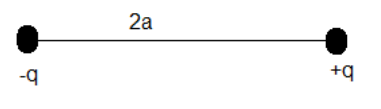
Hint: An electric dipole consists of two charges that are equal in magnitude (q) but opposite in polarity. (i.e. one is a positive charge and other is a negative charge). The two charges are separated by a distance of 2a.
Formula used: V

=Kqr (1±x)n≈1±nx,

if x is very much small.

Complete step by step answer:
An electric dipole consists of a pair of charges that have the same magnitude [latex](q)[/latex] but are opposite in nature. (i.e. one is a positive charge and other is a negative charge). The two charges are spaced apart by a distance of [latex]2a[/latex]. An electric dipole is characterized by a property known as the dipole moment, represented as [latex]P = 2qa[/latex]. Below is an illustration of an electric dipole.
seo images

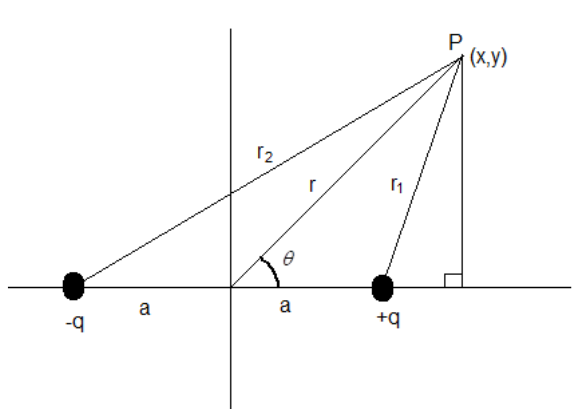
Let an electric dipole with charges +q and –q lie on x-axis with the origin as the midpoint of the dipole.
Consider a point P at the coordinates (x,y). The distance of the point from origin be r making an angle θ with positive x-axis.
seo images

Electric potential due to a charge q at a point, which is at a distance r from the charge is given as 

V=Kqr

Where V is the potential due to the charge and K is permittivity of free space. Now, the electric potential at point P will be due two charges (+q and -q).
Let the potential due to charge +q be

V1,

Let the potential due to charge -q be 

V2,

Let the total electric potential due to both the charges be V.
Since, electric potential is a scalar quantity, 

V=V1+V2

If you see the given figure,

V1=Kqr1………………(i).
Since, is right-angled triangle, 

r12=(x−a)2+y2

⇒r1=(x−a)2+y2

Substitute the value of 

r1

in equation (i).
Therefore, 

V1=Kq(x−a)2+y2  /And V2=−Kqr2………. (ii).
Is also a right-angled triangle. Therefore, 

r22=(x+a)2+y2 ⇒r2=(x+a)2+y2

Substitute the value of r2/in equation (ii).
Therefore, 

V2=−Kq(x+a)2+y2

This implies that 

V=V1+V2=Kq(x−a)2+y2−Kq(x+a)2+y2


V=Kq(1(x−a)2+y2−1(x+a)2+y2)…….(iii)
Consider the expression

(x±a)2+y2

open up the brackets.

⇒x2±2ax+a2+y2…………… (1)
But 

x2+y2=r2

Therefore, expression (1) can be written as

r2±2ax+a2

Since r>>>>a, 

r2±2ax+a2≈r2±2ax

From the figure we know, 

x=rcosθ

Substitute the value of x in the above equation.
Therefore,

r2±2ax=r2±2arcos⁡θ

Take 

r2

as a common term.

⇒r2±2arcos⁡θ=r1±2acos⁡θr

…….(2).
Here, 

2acos⁡θr

is a very much small value because r>>>>a.Any term 

(1±x)n≈1±nx  ,

if x is a very much small value or almost equal to zero.
Let us use the same concept in equation (2).
Therefore, 

r1±2acos⁡θr=r(1±2acos⁡θr)12≈r(1±12(2acos⁡θr))=r(1±acos⁡θr)=r±acos⁡θ

Hence, we get that

(x±a)2+y2≈r±acos⁡θ

Therefore,

(x+a)2+y2≈r+acos⁡θ

and 

(x−a)2+y2≈r−acos⁡θ

Thence we can write equation (iii) as

V=Kq(1r−acos⁡θ−1r+acos⁡θ) ⇒V=Kq(r+acos⁡θ−(r−acos⁡θ)(r−acos⁡θ)(r+acos⁡θ)) ⇒V=Kq(r+acos⁡θ−r+acos⁡θ(r2−a2cos2θ)) ⇒V=Kq(2acos⁡θ(r2−a2cos2θ))

We know that 2qa=P.

⇒V=KPcos⁡θr2−a2cos2θ

……..(iv).
Therefore, the electric potential due to an electric dipole at a given point is equal to 

KPcos⁡θr2−a2cos2θ

Special cases:
(i) When the given point is on the axial line of the dipole (i.e. 

θ=0

).
Substitute

θ=0

in equation (iv).
Therefore, 

V=KPcos⁡0r2−a2cos20

We know 

cos⁡0=1

Hence, 

V=KPcos⁡0r2−a2cos20=KPr2−a2

(ii) When the given point is on the equatorial axis of the dipole (i.e. 

θ=π2

)
Substitute 

θ=π2

in equation (iv).
Therefore, 

V=KPcos⁡(π2)r2−a2cos2(π2)

We know 

cos⁡(π2)=0

Hence, 

V=KPcos⁡(π2)r2−a2cos2(π2)=KP(0)r2−a2(0)=0

When a point lies on the equatorial axis, the electric potential at that point becomes zero. You might question why

rr

must be significantly larger than

aa

.

Note:

This condition is justified because the concept of a dipole is essential in understanding molecules, which often exist as dipoles. For instance, in a water molecule, the bond between the oxygen and hydrogen atoms creates a dipole moment. The distance between these atoms is very small and can be considered negligible compared to the distance

rr

from the midpoint of the dipole.

7activemedical class 12 dipole class 12 electric dipole dipole potential derivation easy derivation electric dipole education electric dipole moment electric field due to dipole electric potential due to a dipole electric potential due to dipole electric potential equation electrostatic potential energy definition potential due to a dipole potential due to an electric dipole si unit of electric potential what is electric potential
Follow on Google News Follow on Flipboard
Share. Facebook Twitter Pinterest LinkedIn Tumblr Email
Previous ArticleHow is Picric Acid Prepared from Phenol? (NEET Chemistry)
Next Article Draw Logic Diagram of EXOR and EXNOR Gate (NEET Physics)

Related Posts

NEET Question Answers

Draw Logic Diagram of EXOR and EXNOR Gate (NEET Physics)

November 19, 2024
NEET Question Answers

How is Picric Acid Prepared from Phenol? (NEET Chemistry)

November 16, 2024
NEET Question Answers

More Conversions of Organic Compounds (NEET Chemistry)

November 15, 2024
Add A Comment
Leave A Reply Cancel Reply

Latest Articles

Meter to Foot Calculator: Ultimate Guide to Convert Meters to Feet Instantly

March 30, 2026

NCERT Book for Class 11 Biology – (Chapter 2 – Biological Classification)

March 28, 2026

NCERT Book for Class 11 Biology – (Chapter 1 – The Living World)

March 28, 2026

NCERT Book for Class 11 Biology – (Chapter 3 – Plant Kingdom)

March 28, 2026
Trending
NEET Question Answers

Draw Logic Diagram of EXOR and EXNOR Gate (NEET Physics)

November 19, 2024Updated:November 19, 2024

(a)Draw logic diagram of EX-OR and EX-NOR gate using NAND gate and proof it using…

How is Picric Acid Prepared from Phenol? (NEET Chemistry)

November 16, 2024

More Conversions of Organic Compounds (NEET Chemistry)

November 15, 2024

Define Molar Conductance of a Solution (NEET Chemistry)

November 15, 2024
Facebook X (Twitter) Instagram Pinterest
© 2026 Gpkumar Technologies.

Type above and press Enter to search. Press Esc to cancel.